
Index:
1 | Vinayakar Lore
2 | Origins of Vinayakar
3 | Vinayakar Iconography
4 | In the World of Gods and Celestials
5 | Vinayakar Worship
6 | Vinayakar in Tamil Nadu temples
5 | Vinayakar worship
As with any deity, there are several approaches to Vinayakar worship. However, because of His popularity in the Hindu pantheon, there are also more people who worship Vinayakar. But how did this develop over time?
Vatapi Ganapati
Not much is known of the events during the so-called “dark period” – the reign of the Kalabhras, who built the Pillaiyarpatti Cave temple. Outside of this, one of the earliest recorded instances of Vinayakar worship in the Tamil country is from the 6th century. Paranjothi (later, Siruthondar Nayanar, the Pallava general under Narasimha Varman I), brought the murti of Ganapati from Vatapi (present day Badami), after defeating the Chalukyas.
Perhaps the first worship of Vinayakar – as Vatapi Ganapati – can be traced to Tiruchengattankudi, where Siruthondar settled later in life. Ganapateeswaram – the name of this place in ancient literature – gives further prominence to Ganapati.
Vighnaraja, Vighneshwara
Many worship Vinayakar first, before setting out for any new or important task, for a good outcome. In the puranams, there are several instances of Vinayakar punishing those who did not pay obeisance to Him before carrying out important tasks. At Tirukadaiyur, He took away the pot of amritam, as He was not invoked before the churning of the ocean. At Chayavanam and Mela Kadambur, He thwarted Indra’s attempts to move the temple to Devalokam. Even His own father – Siva – was not exempt from this requirement! Such stories are present in the sthala puranams of several temples.
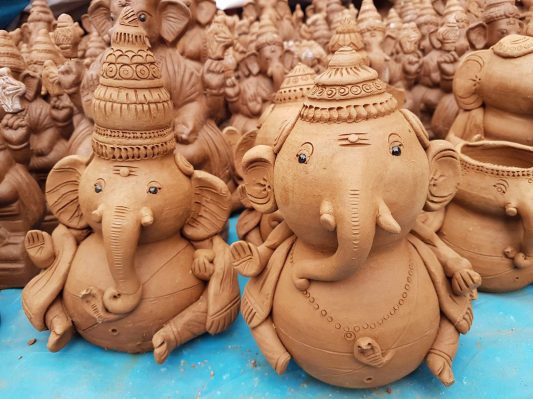
Sumukha – at every street corner
In south India, and particularly in Tamil Nadu, virtually every street corner has a small shrine for Vinayakar. Why so?
In the South Indian stories, Vinayakar remains a bachelor because he refuses to get married to anyone who was not as beautiful as his mother, Parvati. So, he is at every almost every street corner, looking at passers-by, and waiting for the right girl to come along.
Herambha
Everyone is affected by the malevolent effects of planets, and it is Vinayakar as Herambha – the protector of the weak – who is at hand to help devotees. Nowhere is this exemplified more than at Suryanar Koil near Kumbakonam, which is itself considered the Navagraham shrine of the Prananatheswarar temple at Tirumangalakudi.
The temple features all the planetary deities in separate shrines. But even before one prays to them, the first worship is offered to Kol Vinai Teertha Vinayakar (who protects from the ill effects of planets). It is only after this that all deities in the temple are worshipped.
Ganesha Sahasranamam – the 1000 names of Vinayakar
Most of us have heard of the Vishnu Sahasranamam, and possibly of the Siva Sahasranamam as well. But did you know there is a Ganesha Sahasranamam too? Not just that, there are two prominent versions of this text. One appears in the Ganesa Puranam, an important part of those belonging to the Ganapatya sect, and is a litany of attributes, aspects and roles of Vinayakar. The other is completely different, and has a list of names all beginning with “ga”.
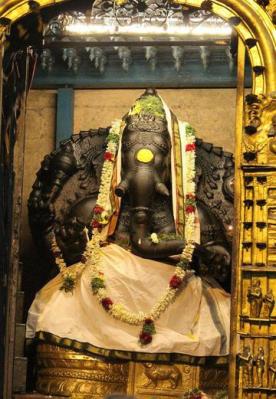
Vikata – Playful yet purposeful
Several stories of Vinayakar are about his playfulness, though each is not without reason, but has a specific purpose. The one standout example of this is from the Ramayanam, where Vibheeshana was taking to Lanka, the murti of Ranganathar that Rama had given him.
At Srirangam, Vinayakar, in the guise of a young boy, took the murti from Vibheeshana for safekeeping, but once the latter had gone for his daily prayers, kept the murti on the ground, ignoring Vibheeshana’s instructions.
This Vinayakar is celebrated and revered as the famous Uchchi Pillaiyar in Tiruchirappalli.
Similarly, He made Indra carry His form made of sea-foam everywhere, until they reached Tiruvalanchuzhi, where Vinayakar settled down for good in front of the temple for Siva as Kapardeeswarar.
Yogadhipa – present in the Muladhara chakra
In Kundalini Yoga, Vinayakar is said to be present in the Muladhara chakra. He forms the base of yogic practice, and supports and guides all other chakras. This association is also attested to in the Ganapati Atharvashirsa.
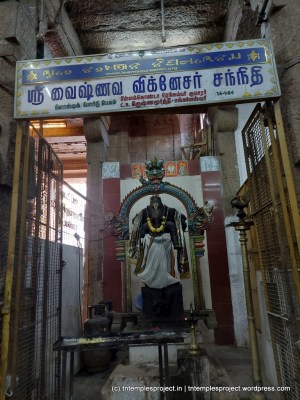
Tumbikkai Azhvar – Vinayakar in Perumal temples
If you do happen to see an elephant headed god in a Perumal temple, don’t be surprised. It is Vinayakar. And while He is the son of Siva, Vinayakar is often regarded and worshipped as a common god by both Saivites and Vaishnavites. So, while it is rare, it is not impossible to see Vinayakar – named Tumbikkai (தும்பிக்கை) Azhvar – at some Perumal temples. Some examples are found at the Prasanna Venkatesa Perumal temple in Madurai, and the Kodandaramar temple at Oottathur near Trichy.
Representations of Vinayakar with Lakshmi and Saraswati
Often, particularly in calendar and commercial art, Vinayakar is depicted with Lakshmi and Saraswati. Why is this the case, when they are certainly not His consorts? Lakshmi and Saraswati represent the aspects of wealth and knowledge – material and spiritual prosperity that Vinayakar is known for – the same way as Siddhi and Buddhi do. And Lakshmi and Saraswati are readily identifiable, and therefore more suited to that depiction in such art forms.
Symbolism of the Vinayaka Chaturti festival
The origin of this festival, celebrated on the chaturti (4th day) following the Amavasya (new moon) in the Tamil month of Avani (August-September), is unknown. Records indicate that in certain parts of India, this festival has been celebrated for at least 350 years. The symbolism of the festival is the arrival of Vinayakar as a clay idol, in people’s homes and lives, to bless them. On the 10th day following the chaturti, ie Pournami (full moon), He is said to go back to Kailasam to be with His parents, which is why the murti is immersed in water.
Previous: In the World of Gods and Celestials Next: Vinayakar in Tamil Nadu temples
 TN Temples Project
Nice round up. Good work. Keep it up.
LikeLiked by 1 person