
Index:
1 | Vinayakar Lore
2 | Origins of Vinayakar
3 | Vinayakar Iconography
4 | In the World of Gods and Celestials
5 | Vinayakar Worship
6 | Vinayakar in Tamil Nadu temples
3 | Iconography
Irrespective of regional variances, almost every single depiction portrays Vinayakar with one tusk missing or partly broken, embodying Vinayakar’s message of giving up one’s pride and ego (which for elephants, is their tusks). Other usual representations involve His vehicle, the mouse, and his pot-belly, among others. In this part, we take a look at the meaning and philosophy behind Vinayakar’s iconography.
Mahakavya-Natakadi Priya
One condition on which Vinayakar agreed to write the Mahabharatam, a Maha-Kavya, was that His pen should not stop writing. But being a fast writer, Vinayakar broke his quill. Not wanting to fail at the condition that He Himself had laid down, Vinayakar quickly broke one of his tusks and used it to continue writing. He did so to honour the word given to Vyasa, who is considered Vishnu-Rupa.
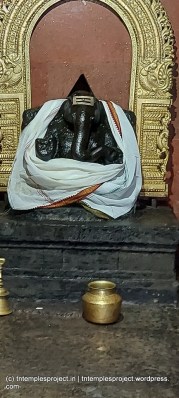
Ekadanta
When Parasurama went to visit Siva, Vinayakar refused to give way to him. Angered, Parasurama hurled his axe at Vinayakar who, respecting that the axe was given to the sage by Siva, let it strike Him and break his tusk. Later, to pacify Parvati’s wrath, Parasurama chanted the Ganesha Nama Shataka, as advised by Vishnu.
Mooshika Vahana
Kayamukhasura was an asura who had received the boon of immortality (with certain exceptions, of course), went back to his evil ways. Siva deputed Vinayakar to subdue the asura. Vinayakar defeated the asura, turned him into a mouse to subdue his ego, and used him as his vahanam (vehicle). The philosophy here is that mice are greedy, always nibbling at things. By worshipping Vinayakar, we are submitting ourselves to his order, and are rid of ignorance and greed, much like Siva does to Muyalakan.
Modaka Priya
In his vanity, Kubera once offered to host Siva for a feast, claiming he could satiate even the most insatiable appetite. Determined to subdue Kubera’s pride, Siva brought little Vinayakar along. At the banquet, Vinayakar started eating, and after some time, it became clear that there was no stopping him. He went after his favourite dish – the modakam – finishing all of it, and then the rest of the food, which was consumed even as it was being cooked in the kitchens. When the host ran out of food, Vinayakar started eating the decorations, flowers and furniture! He even threatened to eat Kubera himself, if His hunger was not satisfied.
Kubera rushed to Siva for succour, and the Lord told him to offer Vinayakar a handful of puffed rice, but with humility and love, and after ridding himself of his pride. Finally, Kubera was able to satisfy Vinayakar’s hunger.
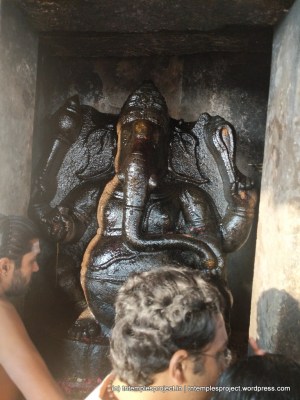
Lambhodara, Bhalachandra
After the feast at Kubera’s Alkapuri, Vinayakar was riding Dinka (his vahanam / vehicle, the mouse) back home, in the full moonlight. A snake crossed their path, frightening Dinka, and so Vinayakar fell off his mount, which broke open his stomach, and the food he had eaten, all fell out. As He was putting it all back in, Chandran laughed at Him, but was instantly cursed that he would go dark forever.
Frightened by this, Chandran begged for mercy, and Vinayakar (as the son of the ever-forgiving Siva), modified the curse, that Chandran’s lustre would wane and wax every 14 days. To enable this, He placed Chandran on his forehead! Once Vinayakar was done putting the contents of His stomach back in, he tied it with the snake that caused all the havoc, and carried on home!
Vakratunda, and Valampura Vinayakar
According to both Vedic and Tantric principles, the right side of the body represents masculine energy (which is why typical Ardhanareeswarar images feature Parvati on the left of Siva).
Vinayakar’s trunk is never straight – it is always bent, usually to the left. This symbolises a peaceful energy and is the preferred type of murti for homes.
At some temples (such as Vaitheeswaran Koil, Maruthanallur and Valivalam, to name a few), Vinayakar is worshipped as Valampura Vinayakar, where His trunk faces to the right. This makes Him the dominant and powerful Siddhi Vinayakar, who blesses devotees with what they ask for. However, being an aggressive force, there are stricter rituals to worship this form of Vinayakar.
32 forms of Ganesa

Depending on various factors, including the applicable agamic principles, Vinayakar is portrayed in one of 32 forms. These are not to be confused with the names given to Him, but are strictly based on the iconography used for the depiction. The 32 forms are: Maha, Bala, Bhakti, Dhundhi, Sakti, Dvija, Ekadanta, Siddhi, Uchishta, Vighna, Kshipra, Kshipra Prasada, Herambha, Sri, Vijaya, Nritya, Urdhva, Ekakshara, Tryakshara, Vara, Srishti, Haridra, Rnamochana, Taruna, Uddanda, Veera, Simha, Dvimukha, Trimukha, Yoga, Durga and Sankatahara Ganapati.
Each of the above representations of Vinayakar have specific meanings and are installed for different purposes. In terms of iconography, these variants primarily differ in terms of posture, number of limbs, what is held in the arms, and accompanying deities. A separate post in the future will deal with these forms, in detail.
Previous: Origins of Vinayakar Next: In the World of Gods and Celestials
 TN Temples Project
Nice round up. Good work. Keep it up.
LikeLiked by 1 person