
Index:
1 | Vinayakar Lore
2 | Origins of Vinayakar
3 | Vinayakar Iconography
4 | In the World of Gods and Celestials
5 | Vinayakar Worship
6 | Vinayakar in Tamil Nadu temples
2 | The origins of Vinayakar
There are several stories on the origins of Vinayakar as a deity who is worshipped. Here, we take a quick look at some of them.
Gauri-Putra
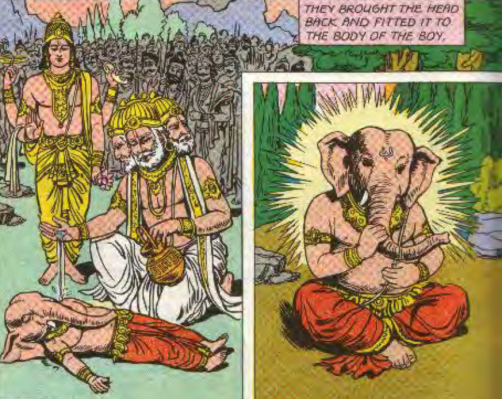
This is perhaps the best-known story on the origin of Vinayakar. Not wanting to be disturbed during her bath, Parvati made an image of a strong young boy, with the turmeric used for her bath, gave it life, and made him stand guard.
Angered by the boy’s refusal to let Him inside, Siva cut off the boy’s head with His trident. When Parvati got to know of this, She summoned all the Shaktis to fight the gods, who had taken Siva’s side.
Worried that this would disrupt the peace Siva and Brahma agreed to Parvati’s requests, to bring the boy back to life, and to ensure he would be worshipped by all.
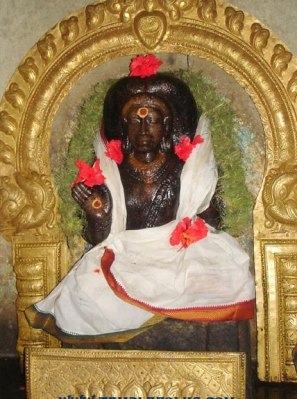
Siva sent his troops to bring the head of the first creature they saw lying down with its head to the north, which happened to be an elephant. This was planted on the boy’s body, making him Gaja-nana, and he was installed as the chief of Siva’s troops – and hence called Gana-pati. Siva also blessed Vinayakar to be the first to be worshipped in any proceedings.
There is a shrine for Adi Vinayakar at Tilatarpanapuri (Sethalapati), just outside the Paadal Petra Sthalam for Mukteeswarar, where Vinayakar is depicted with a human head.
Mahadeva-Suta (and Sani’s destructive gaze)
When a handsome young boy was born to Siva and Parvati, the celestials paid a visit to see the new-born. In the puranams, Sani’s gaze is said to have malefic effects, and so he did not wish to look at the child directly, choosing instead to look from the corner of his left eye. But Parvati insisted that he look at the child directly, and when he did so, the child’s head fell off.
Vinayakar’s head falling off as a result of Sani’s gaze, is part of the sthala puranam at the Agneeswarar temple at Tirukollikadu.
Seeing His sister distraught, Vishnu brought the head of a young elephant from the banks of the Pushpa Bhadra river, and joined it with the body of the child, making Parvati’s happy.
Gajanana, Gajamukha
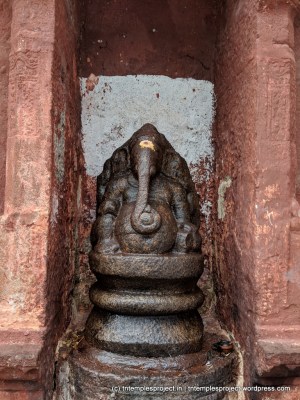
Gajasura – a demon in the form of an elephant – worshipped Siva by undergoing arduous penance. He was first granted a boon of emanating fire from his body, at will, so that nobody could approach him. After further penance, Gajasura sought a boon that Siva should inhabit his stomach. The guile-less Siva agreed to this, but when He did not return, a worried Parvati asked Vishnu to locate Siva.
Vishnu realised what had happened and, with the help of Nandi as a dancing bull, played the flute so beautifully, that it sent Gajasura into raptures. He then granted the flautist (Vishnu) a boon to ask for anything, and Vishnu said he wanted Siva out of the asura’s stomach.
The Veeratteswarar temple at Vazhuvur (one of the Ashta Veerattam temples) is dedicated to Siva as Gajasamharamurti, where he came out of a rogue elephant, tearing its skin, and wearing it as a body covering. In the story of Bhikshatanar, the rogue elephant is sent by the egotistic purva-mimamsaka sages in Darukavanam.
Realising this could have only been Vishnu, and that bringing Siva out would result in his own end, Gajasura asked for two last wishes – one, that everyone should worship him, and two, that Siva should wear his skin as a covering for the body.
Previous: Vinayakar Lore Next: Vinayakar Iconography
 TN Temples Project
Nice round up. Good work. Keep it up.
LikeLiked by 1 person