
Index:
1 | Vinayakar Lore
2 | Origins of Vinayakar
3 | Vinayakar Iconography
4 | In the World of Gods and Celestials
5 | Vinayakar Worship
6 | Vinayakar in Tamil Nadu temples
4 | In the world of gods and celestials
Being the son of Siva and Parvati comes with its own attendant stories and attention. Throw into the mix, consorts and an aggressive younger brother, and you have quite a few stories!
Skanda-Purvaja
In most retellings, Vinayakar is considered the older brother of Murugan (there are some exceptions, though). That notwithstanding, the story about Vinayakar and Murugan’s the race around the world – a classic tale of sibling rivalry – is well-known. While the younger Murugan circled the world three times, older brother (and presumably the favourite child?) Vinayakar circled His world – His parents, Siva and Parvati – thrice, and won the prize – a mango.
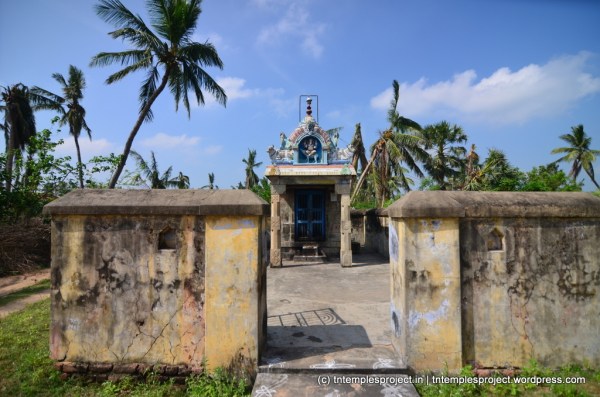
The sthala puranam of Karpaganathar temple at Karpaganathar Kulam in Tiruvarur district, regards that to be the place where the events of the race took place. Abutting the temple on the south is a smaller, east-facing, shrine dedicated to Karpaga Vinayakar.
Guruguhanuta
In Sangam literature, some Tevaram pathigams, as well as parallel interpretations of Siva as Gajasamharamurti, there are stories of how Vinayakar helped Murugan make Valli fall in love with him.
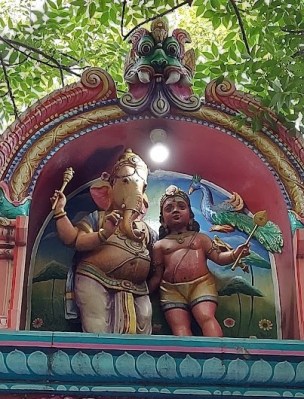
Murugan wanted to demonstrate his bravery to her but was unable to attract Valli’s attention. So Vinayakar took the form of a rogue elephant, and frightened Valli, who ran into Murugan’s arms for help.
Then Murugan ostensibly drove away the elephant, and made Valli fall in love with him! Ever since, Murugan has nothing but admiration, respect and praise for his brother, Vinayakar.
Ganadhyaksha, Ganapati
Once, when Vinayakar was a child, the Devas held a race around the world, to decide who would head the Ganas – the troops of Siva. Each celestial and god took off on their respective vehicles, as did Vinayakar on Dinka, his mouse, which made it slow as it was. To compound his situation, Narada – a single brahmin – was the first person he saw on his way out, and took this to be a bad omen. Making it worse, Narada asked Vinayakar where He was headed – another inauspicious thing.
According to its sthala puranam, Vinayakar received the title “Ganapati” at the Nageswarar temple at Tirunageswaram.
Vinayakar was very disappointed that he wouldn’t win the race, but Narada asked Him who or what was most important to Him. Vinayakar replied that it was His mother, Parvati – the child’s entire world. So Narada asked him to worship her. Vinayakar did so, and Parvati declared Him to be the winner and, as a result, the head of the Ganas, over other competitors who had more speed but lesser understanding.
Brahmachari or polygamous
While there are regional variations, typically in the north, the norm is for Murugan to be portrayed as the bachelor, and Vinayakar with his consorts Riddhi (prosperity), Siddhi (spiritual power) and Buddhi (intellect).
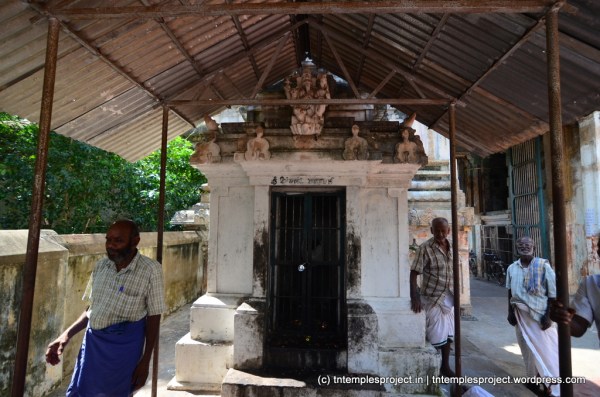
However, in the south (and particularly in Tamil Nadu), it is generally the reverse. Vinayakar is typically depicted as the bachelor on the look-out for his future wife (see separate story on Vinayakar at every street corner, below).
Riddhi and Siddhi are embodiments of Vinayakar, which are depicted as His consorts. The north Indian tradition goes further to suggest, at least in concept, Subh and Labh as Vinayakar’s children.
The specific representation of Vinayakar in temples and shrines depends on various factors, including the beliefs of the person constructing the shrine, and in the case of larger temples, requirements and specifications in the applicable agamas. So, while generally portrayed as a bachelor, there will always be exceptions, such as Vinayakar along with Siddhi and Buddhi (typically, Riddhi is not present in the south Indian depictions), or Uchishta Ganapati (like the one at Sakthi Mutram near Kumbakonam).
Previous: Vinayakar Iconography Next: Vinayakar Worship
 TN Temples Project
Nice round up. Good work. Keep it up.
LikeLiked by 1 person