
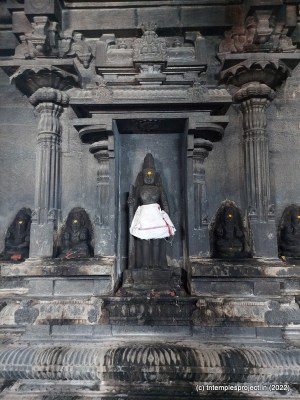
Swamimalai temple is one of the 6 Arupadai Veedu temples of Murugan. The chief deity here is Murugan as Swaminatha Swami – the Lord of the Lord – named so because Murugan gave upadesam and the meaning of the Pranava Mantram, to Lord Siva (Swami) here. Therefore, as the teacher or Guru of Swami, Murugan became Swami-Natha. But how did all this come to happen, and how is that connected to Lord Siva’s journey?
The story actually begins in Alagaputhur (Arisi Karai Puthur) near Kumbakonam. On his visit to Kailasam, Brahma did not pay heed to Murugan, which annoyed the latter. When Murugan asked who he was, Brahma replied with pride that he was the creator of the world. Murugan then asked him about the power under which creation took place, to which Brahma responded as “Om”.
So, Murugan asked Brahma the meaning of the Pranava Mantram, but Brahma admitted to his ignorance in this regard, and for this, he was imprisoned by Murugan. When Lord Siva came to know of this incident, He asked Murugan if the latter knew the meaning, to which Murugan replied that he did. The Lord then asked His son to tell him the meaning, but Murugan replied, that because this was in the nature of upadesam (spiritual instruction), this could be done only if Lord Siva approached Murugan as a student.
Of course, all of this was part of the Lord’s play – in equal parts, both indulging and testing His son, Murugan.
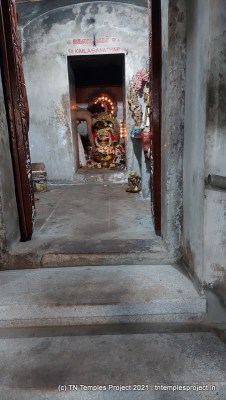
In order to fulfil the requirement imposed by Murugan, Lord Siva arrived at Tiruvaiyaru, also known as Then Kailasam (southern Kailasam). As is usually the case, He was accompanied by his attendants and parivara devatas (associated deities). But in addition, Siva always carries with him certain identifiers, as well as certain aspects / forms, and naturally, these too arrived with him at Tiruvaiyaru.
When one goes for spiritual instruction as a student – the brahmacharya asrama – one’s family and other supports need to be left behind. This meant that Lord Siva had to reach Swamimalai alone. In order to do so, as He started His journey from Tiruvaiyaru, He left members of his family, parivara devatas, identifiers and His aspects at different places along the route. Many of these places find their names based on who or what stayed behind at that place:
- At Thingalur (which is also a Chandra dosha parikara sthalam and one of the Kumbakonam Navagraham temples dedicated to Chandran), He left the crescent moon that He normally wears on His head (Thingal, in the name of the place, also refers to the moon in Tamil)
- Brahma, who accompanied Siva, decided to stay behind at Brahmapuram, which goes by Peramur today
- At Vairavan Koil, He left behind His Bhairavar aspect
- Eachangudi was where His status as the Lord – Easwaran – stayed back (Eachangudi is a corruption of Easwaran Kudi)
- His Somaskandar aspect was left behind at Someswarapuram
- Nandi remained at Iluppakorai
- At Veeramangudi, the Navagraham deities were left behind, along with their respective consorts (even today, the Navagraham shrine at this temple depicts the 9 Navagraham deities along with their consorts)
- The devas accompanying Siva from Kailasam, stayed behind at Devankudi
- Mariamman – a fierce form of Sakti / Parvati –was dispatched to nearby Manalur
- Vinayakar (Ganapati) decided to take up residence at Ganapati Agraharam
- Parvati – also called Uma – stayed back at Umayalpuram to be the deity of the place (Umaiyalpuram literally translates to the place ruled by Uma)
- The aspect of Siva represented by the matted locks from which the River Ganga which flows, was left behind at Gangadharapuram
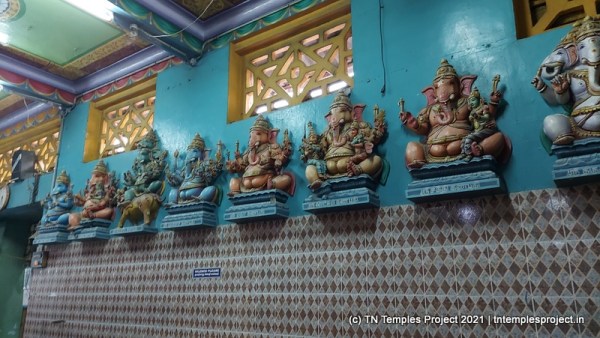
It is considered highly sacred to traverse this path that Lord Siva Himself took, from Tiruvaiyaru to Swamimalai.
In addition, there are several more temples on this route, including the Dayanidheswarar temple at Vada Kurangaduthurai (a Paadal Petra Sthalam temple), and the Vaiyam Katha Perumal / Jagat Rakshaka Perumal temple at Tirukudalur (a Divya Desam temple).
 TN Temples Project